
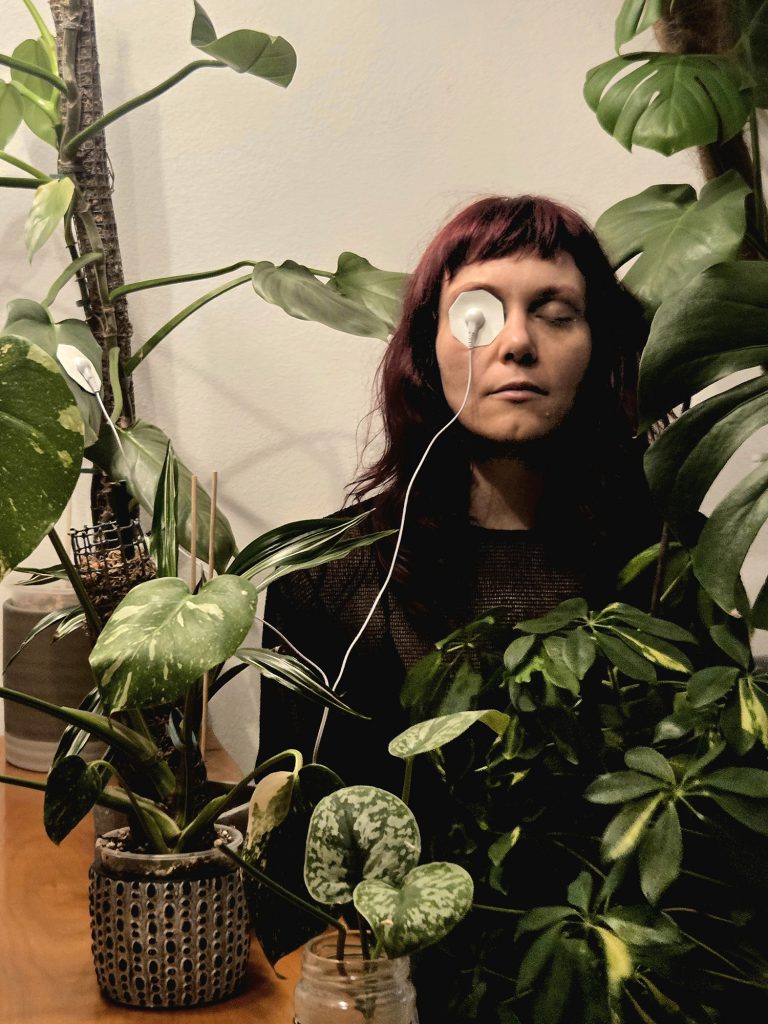
Photo: Nastja Ambrožič
28 August – 19 September 2026
P74 Gallery
You are cordially invited to attend the opening of the exhibition ZVena by nastja Ambrožič on Friday, 28 August 2026, between 7pm and 9pm at the P74 Gallery in Ljubljana.
The exhibition will be on view till 19 September 2026 at the usual opening hours of the Gallery (monday to friday, 12.00 to 18.00, extra viewings upon individual arrangement).
______
At a time when the exploitation of natural resources and the climate crisis reveal how ignorant we have become of voices that are not our own, Nastja Ambrožič’s ZVena project proposes a different kind of relationship: instead of merely observing living organisms from afar, she proposes we enter their bioelectric processes – literally, electrically, with our bodies. This intermedia bioart installation establishes listening as an embodied interspecies contact between plants, fungi and humans. ZVena can be understood as a hybrid bio-technological organism, composed of various interconnected organs. It does not attempt to translate the processes that occur within organisms, but rather captures and interprets them sonically in their own bioelectric range.
The human body that enters the installation becomes a conductor – by touching an electrode in the installation, the observer’s own body conductivity includes them in an electrical circuit. It thus modulates the sound that is coming from the bioelectric signals of plants and mycelium. All organisms in nature create measurable bioelectric changes – the signals of the fungi and plants are captured in real time and transmitted to technological units. The artist and her collaborators are using the DIY principle. The sound moves between slow, organic waves and unexpected rhythmic pulses – the living organisms in this installation are unpredictable, unstable collaborators who do not follow any score. The space becomes a resonant body: the sound does not come from a single source, but from a network of bodies that listen to each other.
In this respect, the installation can also be understood and experienced more intuitively, as an attempt to re-establish communication that many cultures before us took for granted – nature speaks, if we only know how to listen. What was once a bare foot touching the soil is in this installation replaced with an electrode touching the skin – a kind of interface that connects bodies into a sonic circuit. The signal that comes from such a contact belongs to no one and everyone at the same time. ZVena listens to nature – as if we were listening to the flow of zoe*, the generative force of life that flows through all living systems and does not distinguish between species. It invites the visitor to become part of the voice of a plant or fungus through touch – not as an observer, but a co-creator* of the flow that can only happen through contact itself. Sound is then not a representation, but a sympoiesis* – a space where we hear ourselves as an electric community, connected in tension, response and potential for a different experience not only of our immediate surroundings but of the entire world.[1]
The exhibition is part of the Open Term for a Young Intermedia Artist series, which the P.A.R.A.S.I.T.E. Institute has been organising since 2016.
Thanks to Simon Turnšek, Kersnikova Institute, Primož Turnšek (Gobnjak), and Vid Pobegajlo.
______
Nastja Ambrožič (1994) is an artist and educator who explores more-than-human ecologies. In her work, she creates situations in which plants, fungi, and other living systems appear as active participants. Using technology as an interface and ritual as a practice, she aims to open up a space for reflection on the ethics of coexistence, care, and interspecies relationships rooted in ecofeminist theories. Her projects have been featured at the CreaTures Festival (MyCoBiont, in collaboration with Taro Knopp, Seville, Spain, 2022) and throughout Slovenia at the Kapelica Gallery (MyCoBiont – in collaboration with Taro Knopp, 2022), the Lighting Guerilla Festival (SymbioSanctum, 2023), Xcenter in Nova Gorica (Perperuna, 2024), Youth Centre Legebitra (Kusare-Gami, 2025), Velenje Gallery (Perperuna, 2025) and Kapelica Gallery (Hyphera, 2026).
______
[1] *The project is related to the concepts of zoe as a generative force of life beyond species boundaries (Rosi Braidotti, The Posthuman, 2013), intra-action (Karen Baraorganisingd, Meeting the Universe Halfway, 2007) and sympoiesis or “co-becoming” (Donna Haraway, Staying with the Trouble, 2016).