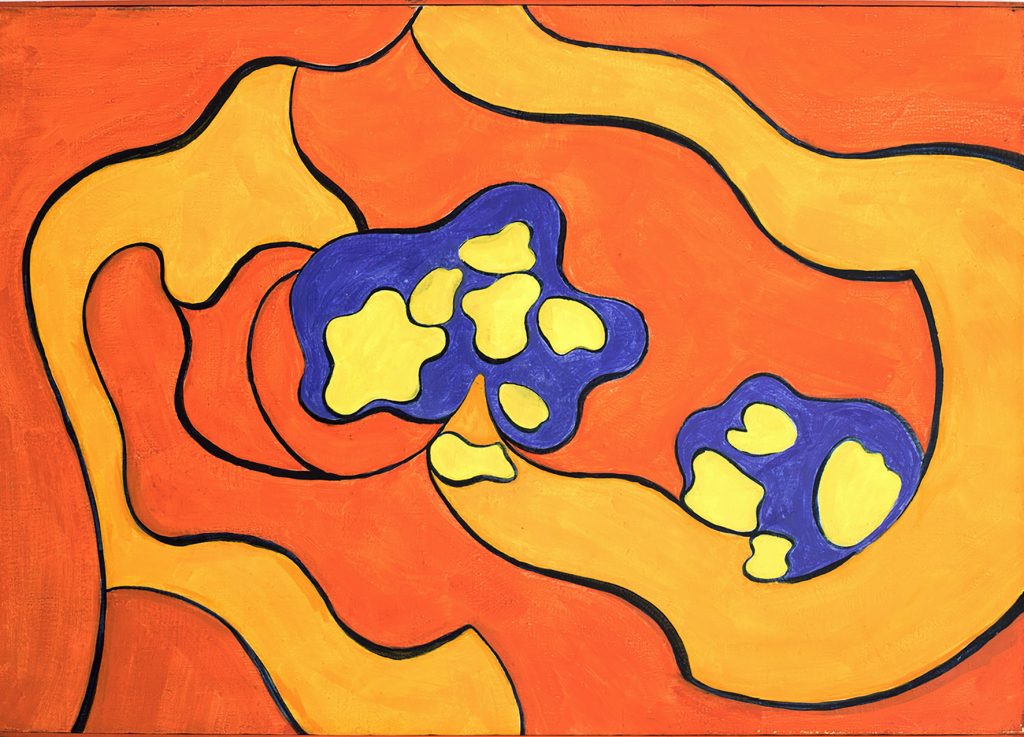
Milena Usenik, Arabeska I., 1972, oil on canvas, 71,5cm x 101,5cm
12 June – 7 July 2026
P74 Gallery
Curator: Tadej Pogačar
______
The exhibition of unknown works by Milena Usenik and Emerik Bernard brings together pieces that have not been exhibited before. We are presenting them in a mosaic way to question conventions and habits. These pieces express tensions between different models of realism, and between series of fragmentary images and symbols.
In the 1970s, the object was a key element in Emerik Bernard’s collages and assemblages. The material aspect of an object is, in these works, torn from reality and brought into the field of painting. Another important element is the specific locations connected to the creation of the works, such as Istria, the Istrian coast, the marshes, and construction sites in Murgle, and, in his later production, a dialogue with painters Kurt Schwitters, Robert Rauschenberg, Jackson Pollock, Barnett Newman, etc. In this way, Bernard approached European New Realism and, later and above all, the haptic new image with palimpsests.
Emerik Bernard and Milena Usenik had successful artistic careers, yet Milena Usenik’s work has been unjustly overlooked in history. This is incomprehensible, since she is one of the most important creators of contemporary visual art, yet has never before had a retrospective exhibition or a serious academic analysis. Decades (and centuries) of sexism have led to women artists being deliberately ignored and disregarded. This is what Lidija Tavčar, head of the educational department at the National Gallery in Ljubljana, notes in her study Absence / Presence of Women Artists in Lexicons and Encyclopedias (2006). Women’s names are mostly omitted from the majority of key art-historical overviews. Academic art history continues to study and glorify mainly the works of famous men. When Andrej Medved discusses Emerik Bernard in his criticism, he never touches upon his own role in co-forming the artist’s symbolic position.
Milena Usenik, a top athlete, in addition to participating in numerous international competitions, achieved 9th place at the 1956 Melbourne Olympics and 12th place at the 1960 Rome Olympics. Between 1971 and 1976, she introduced an innovative combination of the principles of optical art, Op Art and Pop Art. Usenik’s main artistic interests were popular culture and consumerism of the late 1960s and early 1970s, which had become part of everyday life. Hence, the interest in Italian fashion shows with handbags, shoes, hats, bows, and scarves. In human society, women have always had to live under patronage and in a limited space. In addition, they have been taught from earliest childhood to constantly observe themselves. As the English critic and painter John Berger points out, in contemporary society, men act, and women show themselves. Milena Usenik did not find a suitable counterpart in Slovenia in the 1970s, as the critics did not recognise her art as important. She exhibited with colleagues, but remained unnoticed as a woman artist. Critics could not even agree on a terminological designation for her painting production and ultimately labelled it as expressive figurative art. Innovative artistic creation never proceeds in a straight line but rather navigates through detours and deviations. What surprises does this exhibition offer?
______
Milena Usenik (b. 1934) studied painting at the Academy of Fine Arts in Ljubljana, graduating in 1965 under the mentorship of Prof. Maksim Sedej, and in 1968 completed her painting specialisation under the mentorship of Prof. Gabrijel Stupica. She died in 2023. Among the internationally significant exhibitions she’d taken part in were the Ludwig Goes POP + The East Side Story exhibition at the Ludwig Museum in Budapest (where works by Eastern and Western artists were juxtaposed for the first time), and prestigious art fairs in Basel, Madrid and Vienna. In 2021, she received the Rihard Jakopič Prize for lifetime achievements.
Emerik Bernard (b. 1937) graduated in 1965 under the mentorship of Prof. Gabrijel Stupica and completed his painting specialisation in 1968, also under Prof. Stupica’s mentorship. In 1990, he was appointed associate professor, and in 1995, he was promoted to full professor. He died in 2022. He exhibited in numerous group and solo exhibitions, including at the Venice Biennale in 1986. In 1987, he received the Prešeren Fund Award for exceptional works exhibited at the 42nd Venice Biennale. In 1997, he received the Prešeren Award for outstanding achievements in fine arts.
Tadej Pogačar is a visual and intermedia artist, lecturer and curator. Since 1995, he has curated more than eighty-five exhibitions of contemporary art, including: Through the Glass, Young Hungarian Art, Škuc Gallery, Ljubljana, 1995; The Taste of City, P74 Gallery, Škuc Gallery, Ljubljana (1999; with Igor Zabel and Gregor Podnar); The Other Museum, P74 Gallery, Ljubljana (2011); Protest. 6 Cases, P74 Gallery / KAPSULA, Ljubljana (2013); The Second Explosion – The 90s, National Museum of Slovenia Metelkova, Škuc Gallery, P74 Gallery, Ljubljana (2016 – 2017); The Victorious Four, P74 Gallery, Ljubljana (2018); Dalibor Bori Zupančič, Processual_70, P74 Gallery (2024).