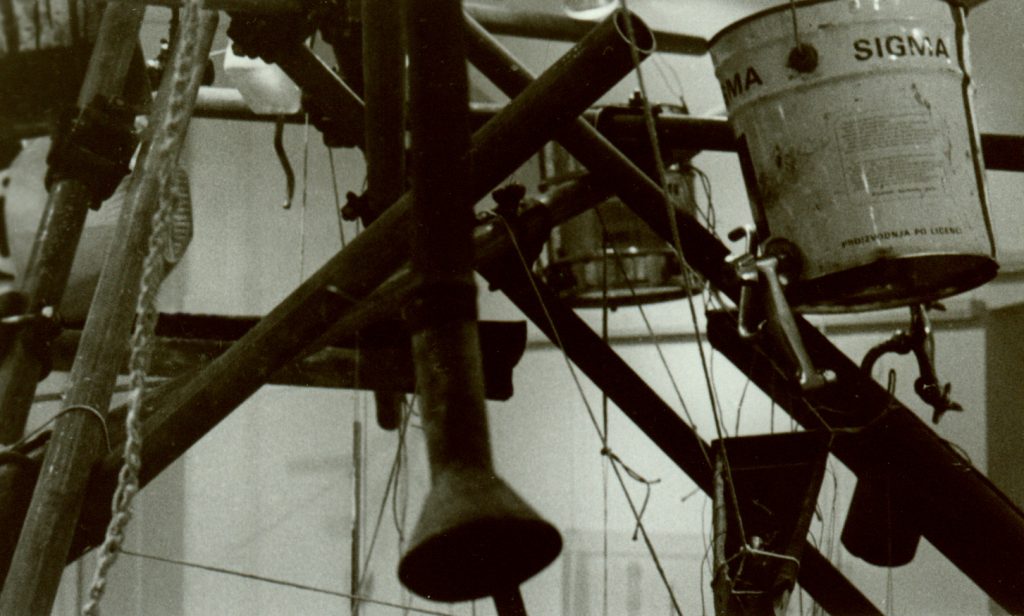
Photo: Dušan Pirih-Hup, Hidrogizma, Škuc Gallery, Ljubljana, 1979.
Curtesy of Nuša Lasič.
29 September – 27 October 2026
P74 Gallery
______
How should we even define Hidrogizma?[1] At the start of our research, we would have probably called it a project, but we wanted to be more precise. Through texts and articles that we’d read and conversations we’d had, we realised that a definite or simple definition would be impossible. On the one hand, this is a sound installation, an aquatic musical instrument, a sound-producing object, a sculpture, and a tool for performance, for bringing people together, and for opening up space; yet, in its elements and performances, it is constantly changing. The Hidrogizma exhibition considers the sequences of its installations and performances, thereby partially outlining the intricate relationship networks and conditions in which particular versions of Hidrogizma emerged. This project is primarily research-based, i.e. the exhibition includes a timeline of selected archival material. The timeline represents the dynamic and prolific three-year period of Hidrogizma’s initial manifestations, enhanced by showcases that anticipated its inception as well as its subsequent re-installations and re-actualisations. The hybrid and collective character of this exhibition makes it an optimal way to present the P.A.R.A.S.I.T.E. Institute’s five-year research project, titled »The Seventies«, pointing to the collaborative and eclectic atmosphere of that era in which different people, practices, media, and ideas circulated.
The creativity that flourished in the 1970s was, in many ways, enabled by the infrastructure of the student environment, particularly in Block IV of the Rožna Dolina student campus. There, the Forum Association opened its space to the SOG screen-printing workshop and to music and theatre groups, thereby enabling crucial informal socialising. These spaces served as gathering spaces for the artists of the early iterations of Hidrogizma, who were working in other spheres as well. Notable examples include the FBRNŽ (New Life Hairdressing and Barber Shop) actions, the Papa Kinjal band, the theatre group Pagadaj pagapust and its successor, The Street Theatre Before Disintegration, and, in the area of literature, the Sub-Realist Manifesto (1979) and a special issue of the Problemi journal titled Aleph Office (1980).
The formation of Hidrogizma is crucially connected to the Kambreško commune, situated on an abandoned farm near the Italian border, where Hidrogizma’s artists gathered in the mid-1970s. It was there that Jani Osojnik, while listening to raindrops falling, got the idea for a sound instrument that would draw on those sounds to create something entirely new. In this context, it is important to emphasise that the well-known OHO commune in Šempas was by no means the only incubator of conceptualism. The first Hidrogizma showcase took place in the winter of 1978 in the exhibition by Iztok Šmajs and Dušan Pirih Hup at the Emonska Vrata Gallery. With pipes as a base material, the sound construction included pots, foils, and barrels that served as reservoirs and resonating plates, while valves were used to gradually regulate the dripping, trickling, and flowing of water. At the exhibition opening, Jani Osojnik performed a suite titled Water States, but the name, Hidrogizma, was not yet in full use.
Each subsequent Hidrogizma was a new, site-specific version of itself, integrating newfound materials and created by an ever larger group of people. These people, listed here in the order they joined Hidrogizma between 1978 and 1981, included Jani Osojnik, Dušan Pirih Hup, Iztok Šmajs, Jani Batista Flavta, Gregor Razpotnik, Andrej Plahuta, Iztok Osojnik, and Vesna Črnivec, as well as other artists who participated in certain editions. The Emonska vrata Gallery exhibition was followed by two versions of Hidrogizma at the Škuc Gallery in April 1979, namely, a smaller one for the Modulations opening ritual, performed by Iztok Šmajs, and a larger, concert version, known as Hidrogizma 2.[2] The next edition followed in July of the same year, again at the Škuc Gallery, as part of the Dušan Pirih Hup and Friends photography exhibition.
Before Nikša Gligo invited them to the Music Biennale (the 10th Music Biennale) at the SKC Gallery in Zagreb, Hidrogizma was showcased alongside exhibitions by its artistic collaborators. With the invitation from Zagreb, however, the dynamic shifted: Hidrogizma became a central event, with participating artists adding their own artworks and actions, while the Street Theatre Before Disintegration performed the opening piece, titled Water Birds.
In 1980, Hidrogizma was recommended by the Kugla Theatre to participate in the Young Theatre Days at the Dubrovnik Summer Festival. Because this was going to be Hidrogizma’s most ambitious version to date, a preparatory version, known as Hidrogizma 6, was staged at the Škuc Gallery a few months earlier. Ultimately, the event in Dubrovnik was not merely a presentation of Hidrogizma but also showcased selected works from Ljubljana’s alternative scene. The Rozario Chapel held a concert performance of Hidrogizma, and the Lazareti Gallery established a creative social space, featuring presentations such as Water Birds by The Street Theatre Before Disintegration, The Masque of the Red Death by the Papa Kinjal Band and other collaborators, as well as a project by Jani Batista Flavta, titled Cooking, that involved the sounds of fire, water boiling and bubbling, and frying food during dinner preparation, as well as other spontaneous actions.
Hidrogizma can be understood as a form of collectivity without a fixed collective, as an open, non-hierarchical connection between people that is not based on strict membership, clearly defined roles, or exclusive individual authorship. While it shares affinities with the avant-garde tradition, Neo-Dadaism, and the practices of the OHO group, these do not indicate a direct or deliberate lineage. Instead – and even though the participating artists had followed their own motivations – these affinities reflect the spirit of the era, which in many ways fostered similar breaks with established artistic forms, concepts of authorship, and institutions. With its openness, processuality, and media crossovers, Hidrogizma is also significant for understanding the practices of subsequent generations, for whom collaboration, ephemerality, and experimentation have become central creative modes. The Ana Monro Street Theatre, for example, can be seen as a successor to The Street Theatre Before Disintegration, and intermedia artist Marko Batista also cites Hidrogizma as an inspiration for his own practice.
Nina Skumavc, Neža Vengust
______
[1] hidrogism
- an experimental sound and spatial device that produces sound by dripping water onto metal and other resonant objects
- a performative act or a temporary constellation comprising water, construction, space, and participants
- an informal and changing group of artists associated with its performances
⟨from hydro– ‘water’ and gizmo– ‘device or gadget of unknown or unspecified name’; the name was reportedly proposed by Hup⟩
[2] The provisional enumerated titles for Hidrogizma’s performances are taken from Dušan Pirih – Hup’s article, Projekt Hidrogizma : 1978–1981, Likovne besede, 63/64 (2003), pp. 138–142.
______
We would like to thank Vesna Črnivec, Nuša Lasič, Iztok Osojnik, and Jani Osojnik for their help with the research, their willingness to share information, and for their assistance in locating and acquiring archival materials. Special thanks also go to OM Production, Miran Mohar, and Barbara Borčič.
We extend our thanks to the Dubrovnik Summer Festival Archive, the RTV Slovenia Archive, the Nova Gorica City Gallery, the Museum of Modern Art Ljubljana / Museum of Contemporary Art Metelkova, the National and University Library in Zagreb, the National and University Library in Ljubljana, and the Maribor Art Gallery.