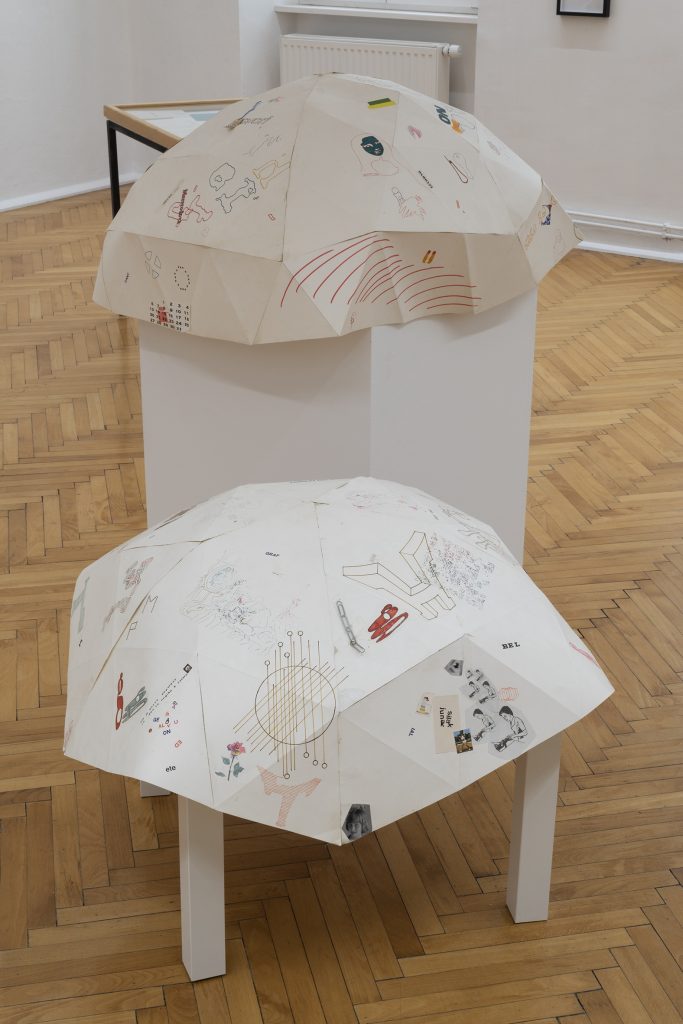
Matjaž Hanžek, Object, 1982
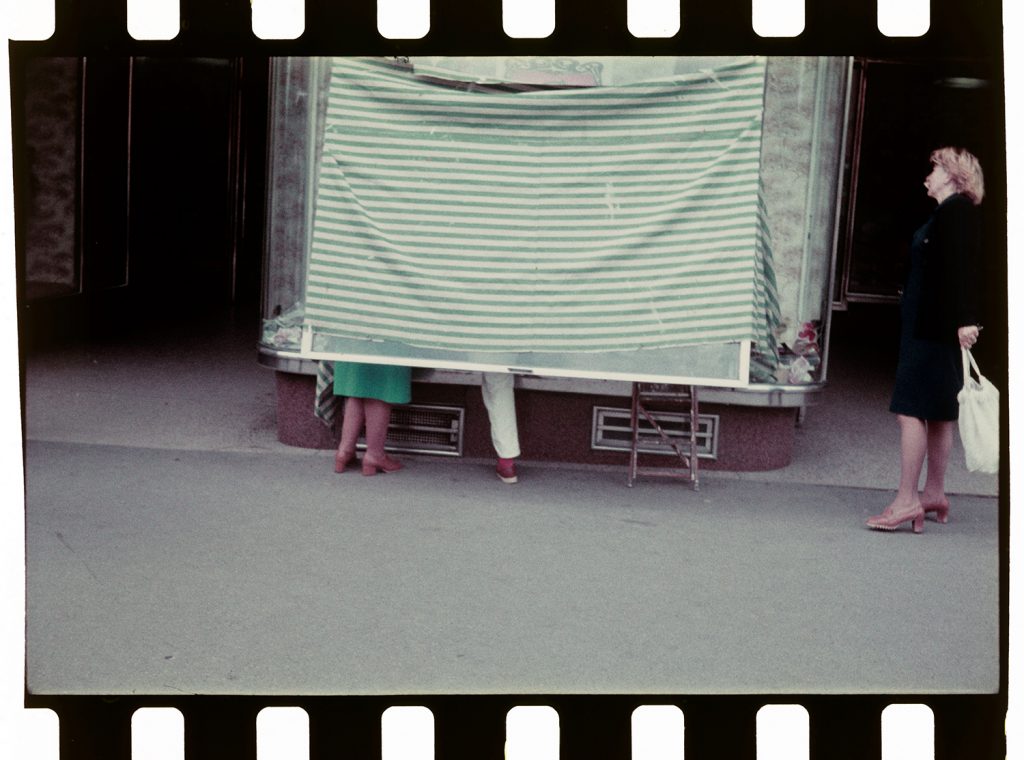
Tadej Pogačar, Vienna, Bratislava, 1980
5 – 21 November 2026
Institute for Contemporary Art, Zagreb
_____
We are delighted to invite you to the opening of the exhibitions by Matjaž Hanžek, Something Completely Else (Sometimes I’m Tempted to Go), and Tadej Pogačar, The Fool on the Hill (Without Words), at the Institute for Contemporary Art, Trg kralja Tomislava 20, Zagreb, on 5 November 2026 at 8:00 PM.
Prior to the opening, at 7:00 PM, we invite you to a presentation of new printed materials and publications by the P.A.R.A.S.I.T.E. Institute and Matjaž Hanžek.
_____
Matjaž Hanžek (b. 1949) is a visual artist, poet, sociologist, and politician. In 1977, he graduated from the Faculty of Sociology, Political Sciences and Journalism, and then took a position at the Institute for Social Planning. As a representative of the local neo-avant-garde, he created the most comprehensive and diverse oeuvre of concrete and visual poetry in our country. His activities in the sixties, seventies and eighties are characterised by varied and open experimentation, ranging from the first publications of poetry in the student newspaper Tribuna to participation in the OHO group, editing the Problemi magazine, working at Radio Študent, and leading the Škuc Association. He published several books, including Spatial Paper (1967), Four Poems (1967), We Are Looking For Poems, Where Are They (1969), and A Washerwoman is Cutting a Duck’s Tail with Aleš Kermauner, Marko Pogačnik, Tomaž Šalamun, Franci Zagoričnik, I.G. Plamen, Milenko Matanović, Vojin Kovač – Chubby, and Slavoj Žižek (1969), Draft (1972), 61 Texts (1977), and Let’s Open the Windows, Burn the Old Rags (essays, 2011). He participated in several group and solo exhibitions, both in Slovenia and abroad.
Matjaž Hanžek’s artistic production is diverse, complex, and multifaceted. Distinctly sceptical, cynical, and destructive in its beginnings, it has always advocated language as its primary medium. Hanžek’s visual poetry has repeatedly transcended the confines of a book, magazine, and printed matter so that it could enter real space as an object or intermedia project. Hanžek has bypassed institutional forms of presentation and developed new informal forms of communication. He collaborated with the OHO group (visual poetry, public actions, videos, and artist books) and was later active primarily in countercultural circles.
_____
Tadej Pogačar (b. 1960) is a visual artist and the founder of the P74 Centre and Gallery and the P.A.R.A.S.I.T.E. Institute in Ljubljana. He graduated from the Departments of Ethnology and Art History at the Faculty of Arts in Ljubljana. In 1988, he also graduated from the Academy of Fine Arts, where he completed his postgraduate studies. Over the past three decades, he has exhibited extensively at some of the most notable local and international exhibition venues, including Gallery MC, New York (2025); Cukrarna Gallery, Ljubljana (2023); Institute for Contemporary Art, Zagreb (2022); Michaela Stock Gallery, Vienna (2020); Edit Russ Haus für Medienkunst, Oldenburg (2019); the 49th Venice Biennale (2001); the 3rd Tirana Biennale (2005); the 2nd Prague Biennale (2005); the 27th São Paulo Biennale (2006); the 10th Istanbul Biennale (2007); the 2nd Canary Islands Biennale, Santa Cruz de Tenerife (2009); the 11th São Paulo Architecture Biennale (2017); and Manifesta 1 in Rotterdam (1996).
Tadej Pogačar is an internationally renowned artist who explores hidden phenomena, social practices, and relationships. In his post-conceptual art practice, he employs interventionist and critical research methods and implements participatory and collaborative practices. In 1990, he founded the Museum of Contemporary Art, which he renamed the P.A.R.A.S.I.T.E. Museum of Contemporary Art in 1993. His exhibition features two of his earliest photography series: ZOO (1979) and Vienna, Bratislava (1980). The ZOO series presents images of captive animals whose natural environment has been changed by humans, who have also taken over the care of their survival. It is a form of a museum installation in which animals are museum exhibits, primarily objects of aesthetic fascination.