Photo: Petra Šimec
8 January – 5 February 2025
P74 Gallery
______
It has become somewhat regular for us to start the calendar year with the YOUNG series, an integral part of the P74 Gallery programme that aims to present and promote young and/or less frequently exhibited artists. This time, after viewing the final-semester exhibitions at art academies, we selected two artists. Both participated in the Ponjava sV student exhibition (7–11 June 2025) that was organised at the initiative of mentors and students from the Department of Photography at the Academy of Fine Arts and Design, which has been showcasing students’ current production across all majors for the past two years. Pika Basaj is finishing her studies at the Department of Painting, while Jernej Šimec at the Department of Photography. We are showcasing their works in two parallel solo exhibitions. These projects are not related by theme or medium, yet both are characterised by processuality and ephemerality. For the second year in a row, art history students from the Faculty of Arts in Ljubljana are also involved in the preparation and implementation of the exhibition. Ana Jazbec, Marta Novak, Vida Šturm, and Aja Topolnik are contributing, among other things, the exhibition texts and interviews with the artists as part of the Exercises in Modern Art II course.
Nina Skumavc
______
Artistic projects sometimes emerge from unexpected impulses, such as discomfort, curiosity, and even boredom. This is how Jernej Šimec first came across the abandoned bed of the Túria River in Valencia – an empty, gradually overgrown line on the city’s outskirts that, following the 1957 floods and the subsequent redirection of the river, became a place of oblivion. The dried-up old riverbed, trapped between two highways and separated from daily city life, created a sense of space that is physically present but cut off from the social flow. Šimec sought to reintroduce this neglected segment of the city into the social context, and this has led to the project titled Un banc per a València (2024/2025).
Šimec did not approach the chosen location through a pre-existing concept, but rather intuitively and physically. He began by drawing maps, walking, measuring the path with steps, and gradually opening access to a place cut off from daily life by infrastructure. The process was long-term and often uncertain; it was mainly driven by a persistent need to understand space through physical presence. The displayed maps, film negatives, and landscape photographs serve as a visual diary of this search – a testimony to a place that can be seen, but not simply reached. They reveal that from the very beginning, the project was primarily a process of coming closer to the place. The artist’s approach is linked to documentary photography and to urban exploration practices, in which moving through space becomes a method of understanding it and a way of existing in it.
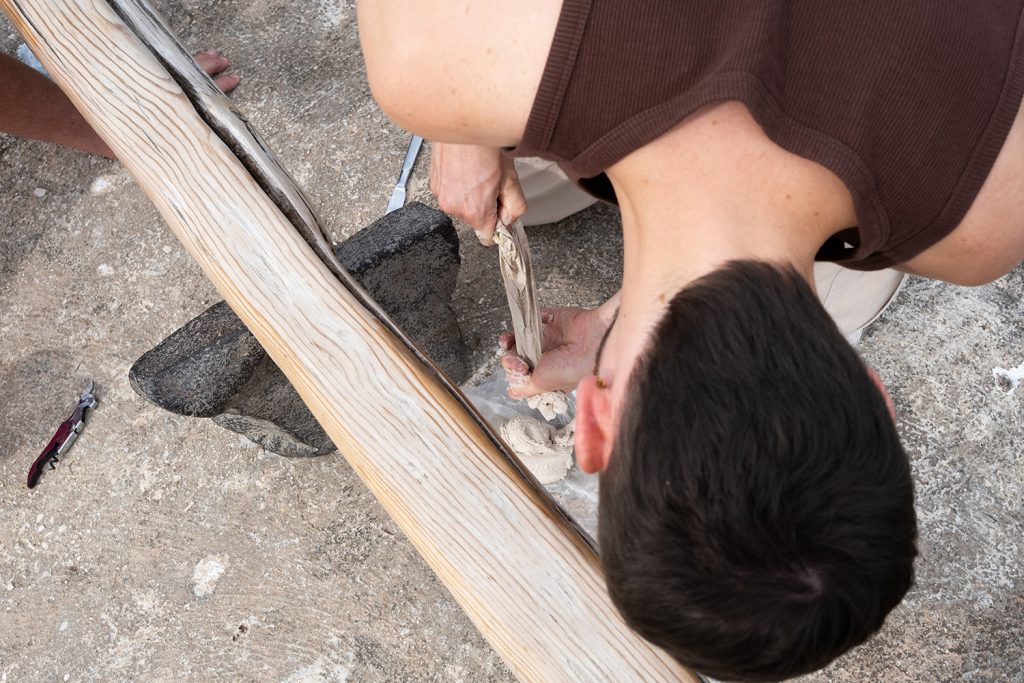
At the completely overgrown end of the riverbed, the artist placed a bench that he’d made in Lisbon and later transported to Valencia. The bench had not been designed as an object that would demand attention on its own, but rather as a device to direct the gaze – a stopping point that momentarily gives meaning to a place abandoned by the city. The emptiness of the riverbed parallels the exhibition space in which everything alludes to the bench – yet the bench itself is missing. The relationship to a particular space continues through the selection of materials collected from the Tagus River estuary in Lisbon. These materials originate from volcanic basalts, geologically entirely different rocks that characterise the surroundings of Valencia. The difference does not create a symbolic link between the two cities; instead, it emphasises the uniqueness of each location: each river carries its own geology, history, and way of shaping space.
Through long-term space exploration and process documentation, Šimec positions the project within the tradition of site-specific art, where the choice of location, the response to it, and the transient nature of interventions are as important as the final object. Since the 1960s, space in artistic practices has no longer been understood simply as a mere site but as a factor that shapes and guides the intervention. Artistic interventions are thus subject to time, natural processes, and entropy. Objects in the space change or disappear, allowing the artist to (un)intentionally play with the paradigm of the art object’s perpetuity.
Five months into the project, the flood washed away the bench. The anticipated, yet still premature, return of the water confirmed that every intervention in the landscape is temporary. Transience is not the starting point of the project, but, given the chosen location, it is an unavoidable circumstance – something the artistic intervention cannot and does not seek to control. The disappearance of the bench, therefore, did not signal the end of the project, but rather its logical progression – the transition to a phase in which absence becomes as significant a part of the object as its former presence. The exhibited materials and documentation thus do not function as a reconstruction but rather as traces of the process: from the first approach to the place to the short bench duration and its disappearance in the flood.
Un banc per a València prompts reflection on how art resides in unstable, inaccessible, and changing spaces, and how the work persists even when it loses its material form. It is based on the connecting gesture between human contact, faced with spatial inaccessibility, and the re-appropriation of space that nature has claimed for itself.
Ana Jazbec, Marta Novak
______
Jernej Šimec (1997) is a visual artist and photographer whose work arises on the intersection of photography, sculpture, and performative practices. He has graduated from the Academy of Fine Arts and Design in Ljubljana, where he is currently pursuing his master’s degree in photography. He expanded his interdisciplinary approach through study exchanges in Warsaw and Lisbon. There, he broadened his artistic interests to include walking as an artistic method and spatial intervention as a sculptural practice. Walking serves in his artistic practice both as an aesthetic strategy and a conceptual framework for spatial exploration, which he documents through various media. His works function as visual and material traces of movement, experimenting with techniques of visual-spatial mapping and examining the relationship between the body and the landscape.
______
Interview with Jernej Šimec (pdf)
The interview was conducted by Ana Jazbec and Marta Novak.